
Sep 26, 2026
How Hydraulic Flow Affects Wheel Loader Multi-Function Performance
A wheel loader is only as capable as the hydraulic system that drives it. Every time you lift a full bucket, tilt a load, or run a powered attachment, hydraulic flow is doing the work behind the scenes.
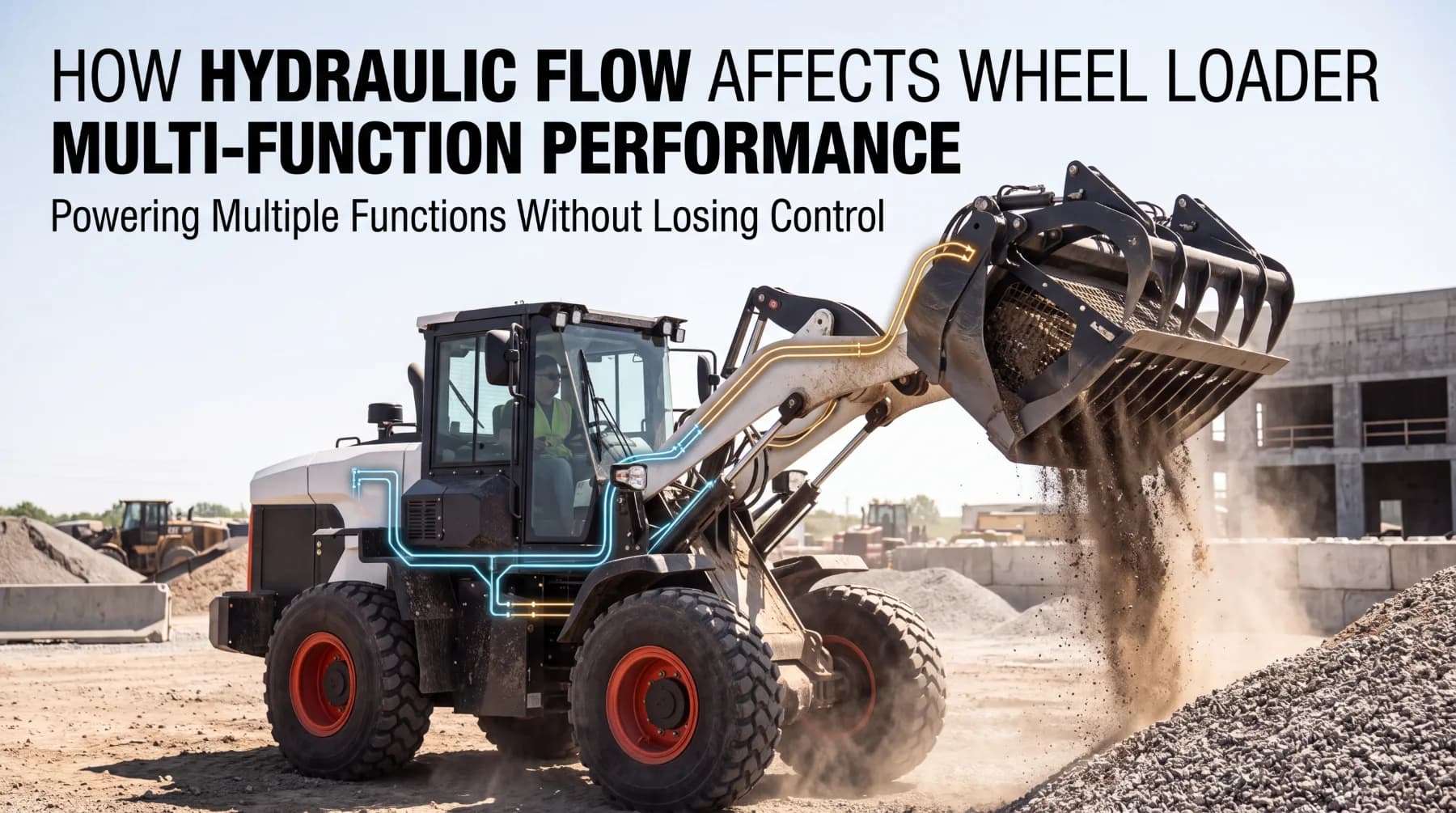
A wheel loader is only as capable as the hydraulic system that drives it. Every time you lift a full bucket, tilt a load, or run a powered attachment, hydraulic flow is doing the work behind the scenes. When that flow is matched well to the machine and the task, the loader responds crisply and handles multiple jobs without hesitation. When it falls short, functions slow down, attachments underperform, and productivity suffers.
This guide explains how hydraulic flow shapes multi-function performance across five key areas. You will see how flow powers core functions, why attachments have specific flow needs, how speed and control work together, what happens during multi-function operation, and how to match hydraulics to the job. By the end, you will know what to look for when selecting a loader and attachments that perform reliably together.
Hydraulic Flow Powers Multiple Functions
Hydraulic flow is the working power behind nearly everything a wheel loader does beyond simply rolling forward. It supplies the energy that lifts the loader arms, tilts the bucket, and drives hydraulic attachments through their cycles. When the operator pulls a lever or moves a joystick, the hydraulic system directs pressurized fluid to the appropriate cylinders or motor, and that flow of fluid is what actually produces the movement. Without adequate flow, these functions have nothing to power them, no matter how strong the rest of the machine may be.
The available flow rate has a direct effect on how quickly each function responds. Flow rate, usually measured in gallons or liters per minute, determines how fast fluid can reach a cylinder and how quickly that cylinder can extend or retract. A higher flow rate generally means the loader arms rise faster, the bucket tilts more quickly, and attachments cycle at a brisker pace. When flow is limited, these same movements slow down, which can drag out each work cycle and reduce how much the machine accomplishes in a shift.
This relationship matters most during real work, where responsiveness translates directly into productivity. An operator loading trucks or clearing material wants the arms and bucket to move promptly and predictably, keeping each cycle tight and efficient.
A few points capture how flow drives these core functions:
- Lifting the arms depends on flow reaching the lift cylinders quickly enough to raise the load at a useful speed.
- Tilting the bucket relies on flow to the tilt cylinders for prompt, controlled crowding and dumping.
- Running attachments requires flow directed to the auxiliary circuit so powered tools operate as intended.
When the flow rate suits the machine and its tasks, the loader feels responsive and capable, handling its everyday functions with the reliability operators depend on.
Flow Rate Affects Attachment Performance
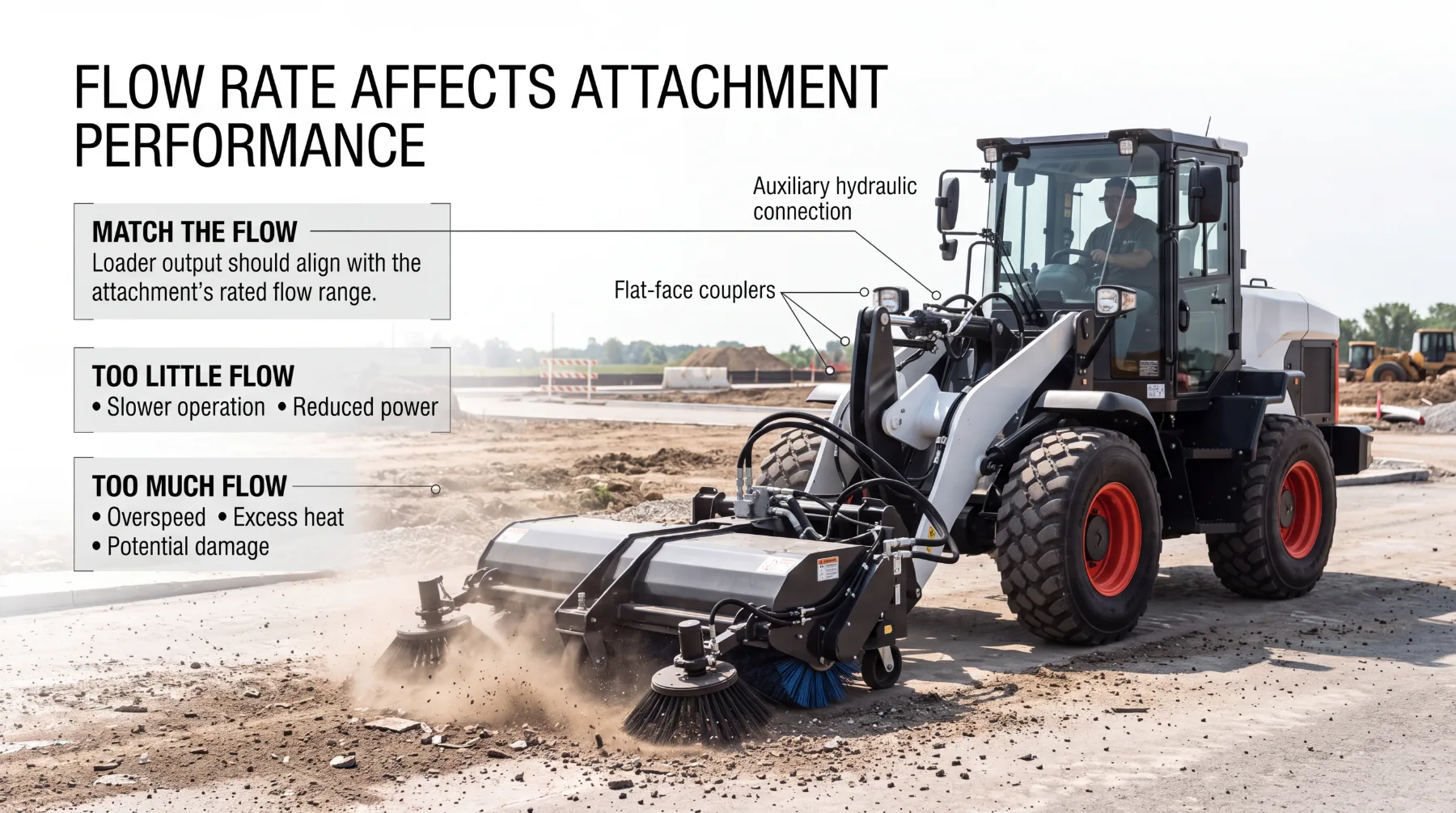
Wheel loaders earn much of their versatility from the attachments they can run, and those attachments depend heavily on receiving the right hydraulic flow. Powered tools such as sweepers, augers, and hydraulic breakers each carry specific flow requirements defined by the manufacturer. These requirements exist because every attachment is engineered to operate within a certain flow range, and delivering flow outside that range keeps the tool from performing as designed.
Matching the wheel loader's auxiliary hydraulic flow to the attachment is what ensures proper operation. When the flow the loader supplies aligns with what the attachment needs, the tool runs at its intended speed and force. A sweeper spins at the correct rate to clear debris effectively, an auger turns with the power to bore cleanly, and a hydraulic breaker cycles at the frequency needed to break material efficiently. Get this match right, and the attachment delivers the performance it was built for.
Problems appear quickly when flow and attachment do not align. Too little flow leaves an attachment sluggish and underpowered, unable to reach its rated performance. Too much flow can overspeed a tool or generate excess heat, which risks damage and shortens the life of the attachment. Neither situation serves the operator, and both undermine the productivity the attachment is meant to add.
Before pairing a tool with a loader, it helps to confirm the numbers:
- Check the attachment's rated flow range against the loader's auxiliary hydraulic output.
- Confirm the loader can supply that flow consistently under working conditions.
- Account for both minimum and maximum limits, since exceeding either end causes trouble.
Taking the time to match flow to each attachment protects your equipment and ensures every tool in your fleet works effectively when it is called on.
Balancing Speed and Control
Higher hydraulic flow can support faster movement of cylinders and attachments, but speed alone does not define good performance. A loader that moves quickly yet unpredictably is harder to operate and less safe than one that moves at a sensible pace with precise control. Real drive and function performance come from balancing the speed that flow provides against the control the operator needs to place loads accurately and run attachments smoothly.
Several factors beyond flow shape this balance. System pressure works alongside flow to determine both the force available and how the machine responds under load. Component sizing, including the dimensions of cylinders, valves, and lines, influences how flow translates into movement and how smoothly that movement occurs. Control settings then govern how the operator's inputs are interpreted, allowing fine adjustments that keep the machine responsive without becoming twitchy or abrupt. All of these elements have to work together for the loader to feel predictable.
Smooth flow management is what ties these factors into dependable performance. When the hydraulic system meters flow well, functions start and stop cleanly, cylinders move without jerking, and attachments run at a steady pace. This predictability lets an operator trust the machine, positioning a bucket precisely or feathering an attachment with confidence rather than fighting sudden surges or lag.
The practical goal is a loader that moves quickly enough to stay productive while remaining controlled enough to work with precision. Chasing maximum speed at the expense of control leads to spilled loads, imprecise placement, and added risk, while overly cautious response wastes time. A well-balanced system delivers both, giving operators the responsiveness they want and the steadiness they rely on across a full range of tasks.
Multi-Function Operation
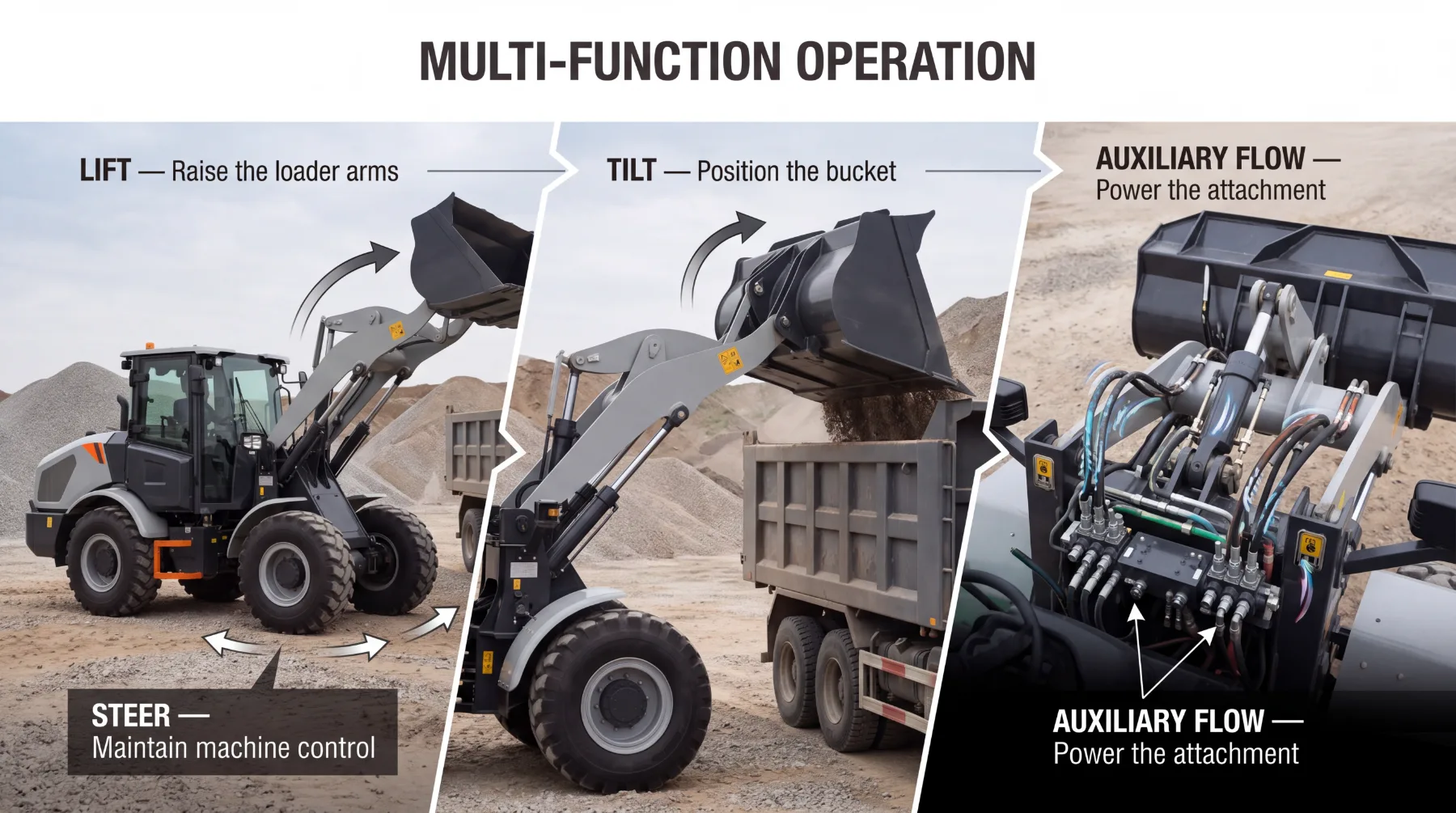
Wheel loaders rarely perform just one hydraulic action at a time. During a single work cycle, an operator may lift the arms while tilting the bucket, steer through a turn, and run an attachment, often overlapping several of these functions. This multi-function operation is where a hydraulic system truly proves itself, because it must distribute flow effectively among competing demands rather than serving one function at the expense of another.
Consider a typical loading cycle to see how these demands stack up. The operator approaches a pile, crowds the bucket to fill it, lifts the arms, steers toward a waiting truck, and then tilts to dump. On loaders with hydraulic steering and powered attachments, the system may need to supply flow to several circuits at once. If the hydraulics cannot manage this distribution well, one function may slow noticeably when another is engaged, which disrupts the smooth rhythm an operator depends on.
A capable hydraulic system handles these overlapping needs by directing flow where it is required while keeping every active function working acceptably. This is why the system's ability to prioritize and share flow matters as much as its total output.
Several functions commonly draw on the system during a single cycle:
- Lifting and tilting the loader arms and bucket to capture and place material.
- Steering the machine, which on many loaders draws from the hydraulic system.
- Operating an attachment, adding another circuit that needs its share of flow.
When the hydraulic system distributes flow effectively, the loader performs these combined actions fluidly, letting the operator work through each cycle without waiting on the machine. That coordinated performance is what keeps productivity high in the demanding, repetitive work loaders are built for.
Matching Hydraulics to the Job
The right hydraulic flow is not a single universal figure. It depends on the loader's design and the specific tasks the machine needs to perform. A loader used mainly for scooping and stacking material has different hydraulic demands than one expected to run a hydraulic breaker or a high-flow attachment for hours at a time. Understanding the work ahead is the starting point for selecting equipment that performs reliably rather than falling short when the job gets demanding.
Both flow rate and pressure deserve attention when making this match. Flow rate governs how fast functions and attachments move, while pressure determines the force available to lift heavy loads and power tools through resistance. Considering these two together gives a complete picture of what a loader can do. A machine with generous flow but limited pressure may move quickly yet struggle under heavy loads, while one with ample pressure but modest flow may handle weight well yet operate slowly. Balancing both against the job is what leads to a sound choice.
Matching hydraulics to the work also means looking at loader and attachment as a pair. An attachment only performs when the loader can supply the flow and pressure it requires, so the two must be selected with each other in mind.
Keeping a few questions in view helps guide the decision:
- What tasks will the loader perform most, and how demanding are they on the hydraulics?
- What attachments will it run, and what are their flow and pressure requirements?
- Does the loader's output comfortably meet those needs under real working conditions?
When flow rate and pressure are matched thoughtfully to the loader's design and its tasks, operators get equipment and attachments that work effectively together. That alignment is the foundation of consistent, dependable multi-function performance across the full range of jobs a wheel loader is asked to handle.
Conclusion
Hydraulic flow sits at the center of how well a wheel loader performs its many functions. It powers lifting, tilting, and attachment operation, shapes how quickly the machine responds, and determines whether powered tools work as designed. Balancing flow with pressure, component sizing, and control settings delivers the smooth, predictable performance operators rely on, and effective flow distribution keeps multi-function work cycles moving without hesitation.
Before selecting your next loader or attachment, review both the flow rate and pressure your tasks demand, then confirm the machine and its attachments are matched to work together. Check attachment flow requirements against the loader's auxiliary output, weigh your most common jobs, and choose equipment that meets those needs under real conditions. Taking that approach ensures your loader delivers the reliable, capable performance every worksite depends on.
Frequently Asked Questions
- What does hydraulic flow actually control on a wheel loader?
Hydraulic flow supplies the working power for most of a wheel loader's functions beyond travel. It drives the cylinders that lift the loader arms and tilt the bucket, and it powers hydraulic attachments through their operating cycles. When the operator moves a control, the hydraulic system directs pressurized fluid to the right cylinder or motor, and that flow produces the movement. The available flow rate, typically measured in gallons or liters per minute, affects how quickly each function responds. A higher flow rate generally means the arms lift faster, the bucket tilts more promptly, and attachments cycle at a brisker pace, while limited flow slows these movements and lengthens each work cycle. In short, flow is what turns the machine's hydraulic power into the practical actions that get work done, which is why matching it to the machine and its tasks matters so much for productivity. - Why do attachments like breakers and augers have specific flow requirements?
Attachments such as sweepers, augers, and hydraulic breakers are engineered to operate within a defined flow range set by the manufacturer. That range exists because each tool is designed to run at a certain speed and force, and delivering flow outside those limits keeps it from performing correctly. When the loader's auxiliary hydraulic flow matches the attachment's requirement, the tool runs as intended: a sweeper spins at the right rate, an auger bores cleanly, and a breaker cycles at the proper frequency. Too little flow leaves an attachment sluggish and underpowered, unable to reach its rated performance. Too much flow can overspeed the tool or create excess heat, risking damage and shortening its life. This is why it is important to check an attachment's rated flow range against the loader's output and confirm the machine can supply that flow consistently before pairing the two. - Does higher hydraulic flow always mean better performance?
Not necessarily. Higher flow can support faster movement of cylinders and attachments, but speed alone does not define good performance. A loader that moves quickly but unpredictably is harder to control and less safe than one that moves at a sensible pace with precision. Real performance depends on flow working together with system pressure, component sizing, and control settings. Pressure determines the force available under load, component sizing influences how smoothly flow becomes movement, and control settings govern how the operator's inputs translate into action. Smooth flow management ties these together, letting functions start and stop cleanly and attachments run steadily. The goal is a machine that moves fast enough to stay productive while remaining controlled enough to place loads accurately. Chasing maximum speed at the expense of control leads to spilled loads and imprecise work, so balance matters more than raw flow. - How does a wheel loader handle several hydraulic functions at once?
Wheel loaders frequently perform multiple hydraulic actions within a single work cycle. An operator might lift the arms while tilting the bucket, steer through a turn, and run an attachment, often overlapping these functions. During a typical loading cycle, the machine may crowd and fill the bucket, lift the arms, steer toward a truck, and tilt to dump, with several circuits drawing on the hydraulic system at the same time. A capable system distributes flow effectively among these competing demands, directing it where it is needed while keeping every active function working acceptably. If the hydraulics cannot manage this distribution well, one function may slow noticeably when another engages, disrupting the operator's rhythm. This is why the system's ability to prioritize and share flow is as important as its total output. Effective distribution lets the loader perform combined actions fluidly, keeping each cycle efficient. - How do I match a loader's hydraulics to the job and attachments?
Start by understanding the work the loader will do most and the attachments it will run. The right hydraulic flow depends on the machine's design and its tasks, so a loader used mainly for scooping material has different needs than one running a hydraulic breaker for hours. Consider both flow rate and pressure together, since flow governs how fast functions and attachments move while pressure determines the force available for heavy loads and demanding tools. A machine with strong flow but limited pressure may move quickly yet struggle under weight, while ample pressure with modest flow may handle loads well but operate slowly. Treat the loader and attachment as a pair, checking each attachment's flow and pressure requirements against the loader's auxiliary output under real working conditions. When flow and pressure are matched thoughtfully to the design and the tasks, the equipment works together dependably.