
Oct 17, 2026
Safety Features for Forklift Operators in Warehouses and Jobsites
Forklifts move pallets, building materials, and equipment efficiently through warehouses, loading docks, and construction sites, but busy work areas create risks from falling loads, restricted visibility, and pedestrian traffic.
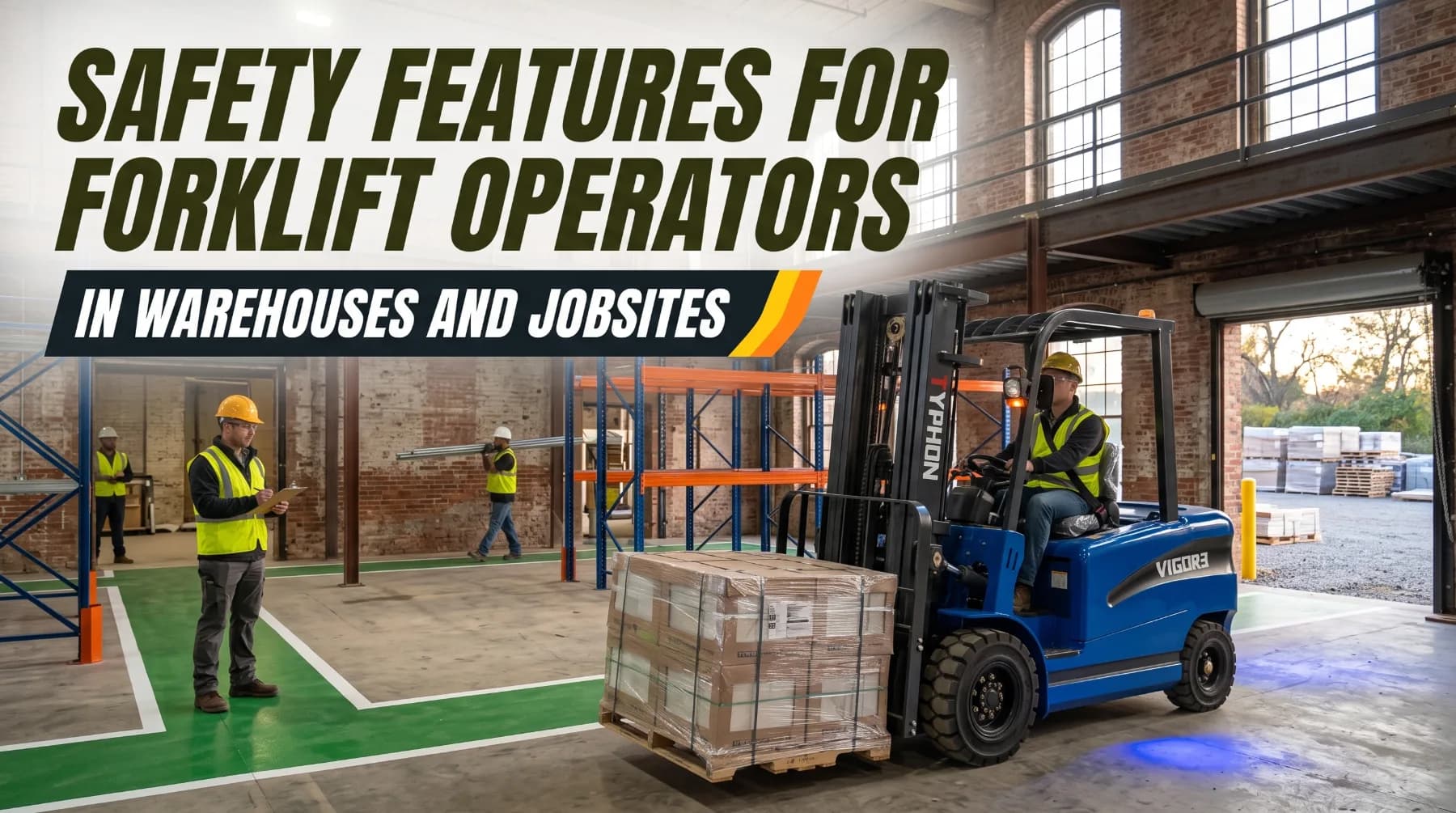
Forklifts move pallets, building materials, and equipment efficiently through warehouses, loading docks, and construction sites, but busy work areas create risks from falling loads, restricted visibility, and pedestrian traffic. Safety features help reduce these hazards when machines are operated correctly and protective equipment remains intact. Removing guards, disabling alarms, or neglecting basic restraints can undermine protection and turn routine material handling into a serious incident.
Overhead guards, seat belts, load backrests, warning lights, backup alarms, and visibility aids each serve a different safety purpose. Load capacity indicators and approved attachments also help operators assess lifting limits, while site conditions such as ramps, gravel, and confined routes influence stability and maneuverability. These features cannot replace proper load positioning, clear sightlines, sound judgment, or training on the specific forklift being used.
Reliable forklift safety starts with inspecting protective features before each shift, repairing defective devices, and keeping equipment in its manufacturer-approved configuration. Operators should secure loads, wear seat belts, travel at controlled speeds, and use approved attachments within their rated capacity. Clear pedestrian routes, barriers at vehicle crossings, and practical operator training help prevent collisions and maintain safer material-handling operations.
Overhead Guards and Operator Protection
The overhead guard is the framework of steel members above the operator's seat or standing position. It's built to help protect the operator from objects that fall from above, such as cartons, bags, small packages, and pieces of loose material that slip off a raised load or a rack. On a jobsite or in a warehouse with high storage, that protection matters every time the mast goes up.
It's important to understand what the guard is designed to handle. An overhead guard helps protect against certain falling objects when the forklift is equipped and used as the manufacturer intended. It isn't intended to stop a full capacity load from crushing the cab, and it can't make every overhead hazard harmless. Falling pallets, collapsing rack sections, and heavy materials dropped from height can exceed what the guard was built to resist. The guard's open design also exists for a reason. It lets the operator see raised loads through the gaps while still providing a barrier against smaller objects.
Changes to the guard can defeat both purposes. Plywood, sheet metal, tarps, and storage boxes fastened on top block the operator's upward view, which makes it harder to place loads accurately at height. Cutting, drilling, or welding the guard can weaken it. In the United States, modifications that affect a forklift's capacity or safe operation generally require the manufacturer's prior written approval. If an operator needs protection from rain, sun, or roof drips, ask the dealer about manufacturer-approved cab enclosures or accessories rather than improvising.
Good habits extend the guard's protection. Operators should avoid traveling beneath unstable loads, overhanging materials, and racks with damaged beams or poorly stacked pallets. Look up before raising the mast, and check that the load you're lifting is stable and secured. Follow site procedures for stacking, storage, and overhead work, and never allow anyone to stand or walk beneath raised forks or a raised load. Report damaged racking and unstable stacks so they can be corrected before someone lifts from or beneath them.
Key takeaway: The overhead guard helps protect the operator from certain falling objects, but it doesn't make every overhead hazard harmless, so never modify or cover it, avoid unstable loads above you, and follow site stacking and storage procedures.
Load Backrests and Fork Security
With the operator protected, the next priority is keeping the load where it belongs. A load backrest extension is the vertical frame mounted on the carriage behind the forks. When the forklift is equipped for that purpose, it helps support loads and reduces the risk of materials shifting or falling back toward the operator, especially when the mast tilts back or the load is raised high.
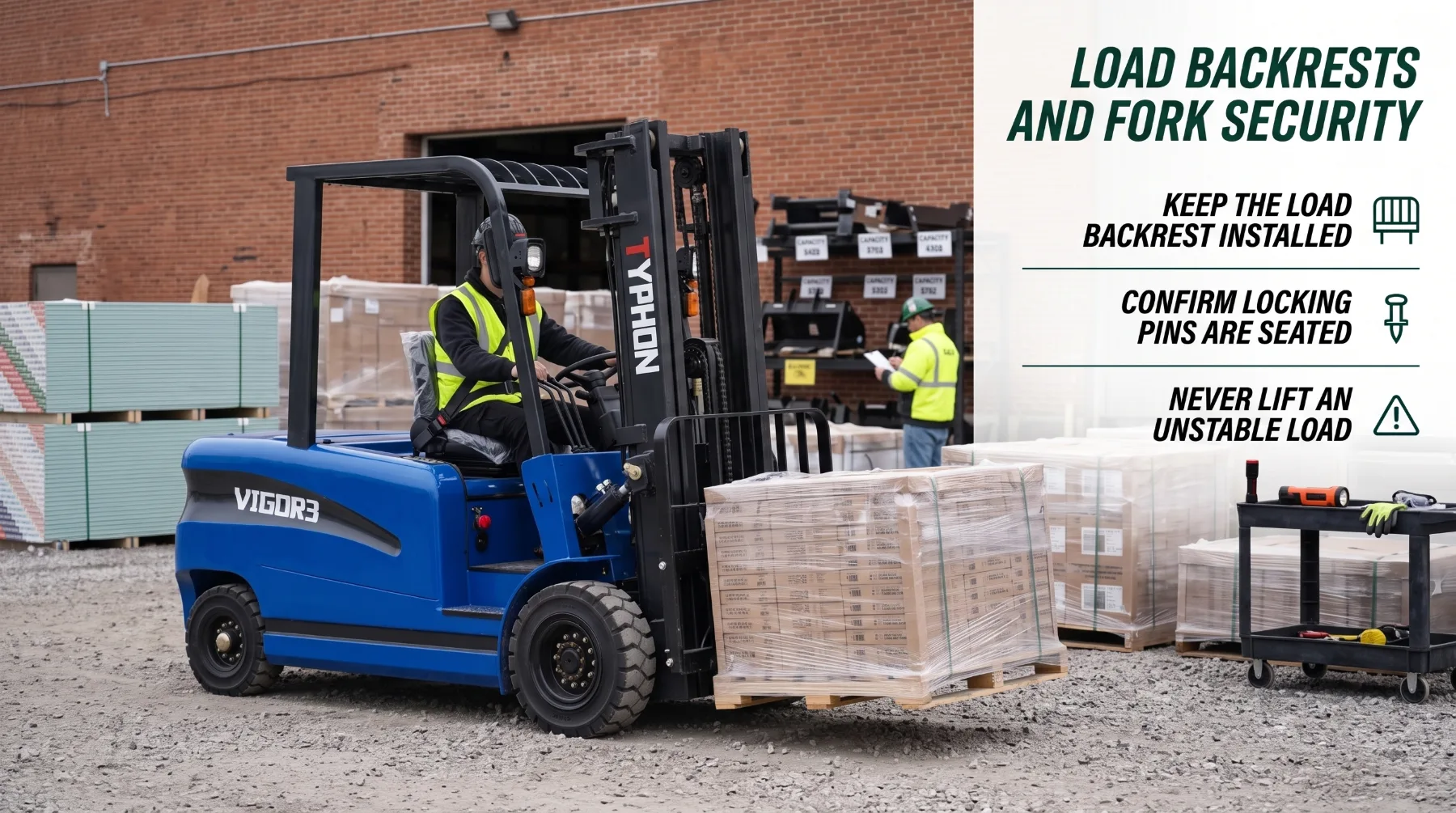
The backrest matters most with loads that are tall, loose, or made of stacked cartons. Boxed tile, bagged mortar, stacked drywall, and cases of product can slide rearward when the mast tilts back to cradle the load. Without a backrest, those materials can fall over the carriage onto the mast, the cab, or the operator. Removing the backrest to carry long or awkward materials, as the food bank crew did, trades one convenience for a serious hazard. When a load won't fit with the backrest installed, use a manufacturer-approved attachment or a different handling method, and confirm that the capacity plate reflects that configuration.
Forks, locking pins, and attachment connections must also remain secure. Forks carry the entire load, and a cracked or bent fork can fail without warning. Locking pins hold the forks in position on the carriage, and a pin that doesn't seat fully can let a fork slide sideways under load. Attachments such as fork extensions, side shifters, clamps, and jibs must be approved by the manufacturer, properly installed, and secured with their specified hardware. Check that both forks are level with each other and that their tips sit at the same height.
Operators should inspect these components before lifting and never carry a load that is unstable or unsuitable for the installed equipment. Before each lift, confirm that the load is stacked squarely, banded or wrapped where needed, and centered between the forks. Insert the forks fully and set the load against the backrest. If materials are loose, leaning, or damaged, restack or secure them before lifting. A few minutes spent correcting a load prevents the kind of sliding cartons that nearly injured the operator on the mezzanine.
Key takeaway: Keep the load backrest installed wherever the forklift is equipped for it, confirm that forks, locking pins, and attachments are secure before lifting, and never carry an unstable load or one unsuitable for the installed equipment.
Stability and Load-Handling Systems
Forklift technology has advanced well beyond mechanical guards and belts. Some forklifts include stability-related technologies or systems that limit certain machine functions under specified conditions. Depending on the model, these can include load weight indicators, overload warnings, travel speed limiting when the mast is raised, automatic tilt angle limits, mast tilt speed control, and dynamic stability systems that monitor the machine during turns. Some models also link operator presence sensors to travel and hydraulic functions.
These systems add real value. A load weight indicator tells the operator how much a load actually weighs, which helps confirm that the lift falls within the capacity plate. Speed limiting with a raised mast reduces the risk of tipping during travel. Tilt control can prevent the mast from tilting forward too quickly with a raised load. Operators should understand every warning their machine can display and know what each one means. On the food bank project, a flashing caution on the load weight display went unnoticed simply because the operator had never learned what it signaled.
Their availability and capabilities vary by model. One forklift may limit speed when the forks rise above a set height, while another may simply sound a warning. Some systems work only within specific load or speed ranges. Read the operator's manual to learn which systems your forklift has, how they behave, and which conditions they're designed to address. Never assume a feature from one machine exists on another.
Most importantly, operators must still respect the rated capacity, load center, attachment limits, and operating instructions rather than relying on electronic systems to prevent every unsafe action. Technology can't make an overloaded forklift stable, correct a load carried far out on the fork tips, or stop a tip-over on a steep ramp taken too fast. Check the capacity plate for each lift, keep loads close to the backrest, carry them low with the mast tilted slightly back, slow down before turns, and follow the manufacturer's guidance for ramps and grades. Treat stability systems as a backup to good judgment, never a replacement for it.
Key takeaway: Stability and load-handling systems add valuable protection, but they vary by model and can't prevent every unsafe action, so learn your machine's systems and always operate within the rated capacity, load center, and manufacturer's instructions.
Visibility Aids and Warning Devices
Many forklift incidents involve people on foot, and most happen because someone wasn't seen or didn't realize the machine was moving. Mirrors, cameras, lights, horns, and other warning devices improve awareness around a forklift for both the operator and nearby workers. On busy jobsites and in crowded warehouses, these tools work together to give everyone a better picture of what the machine is doing.
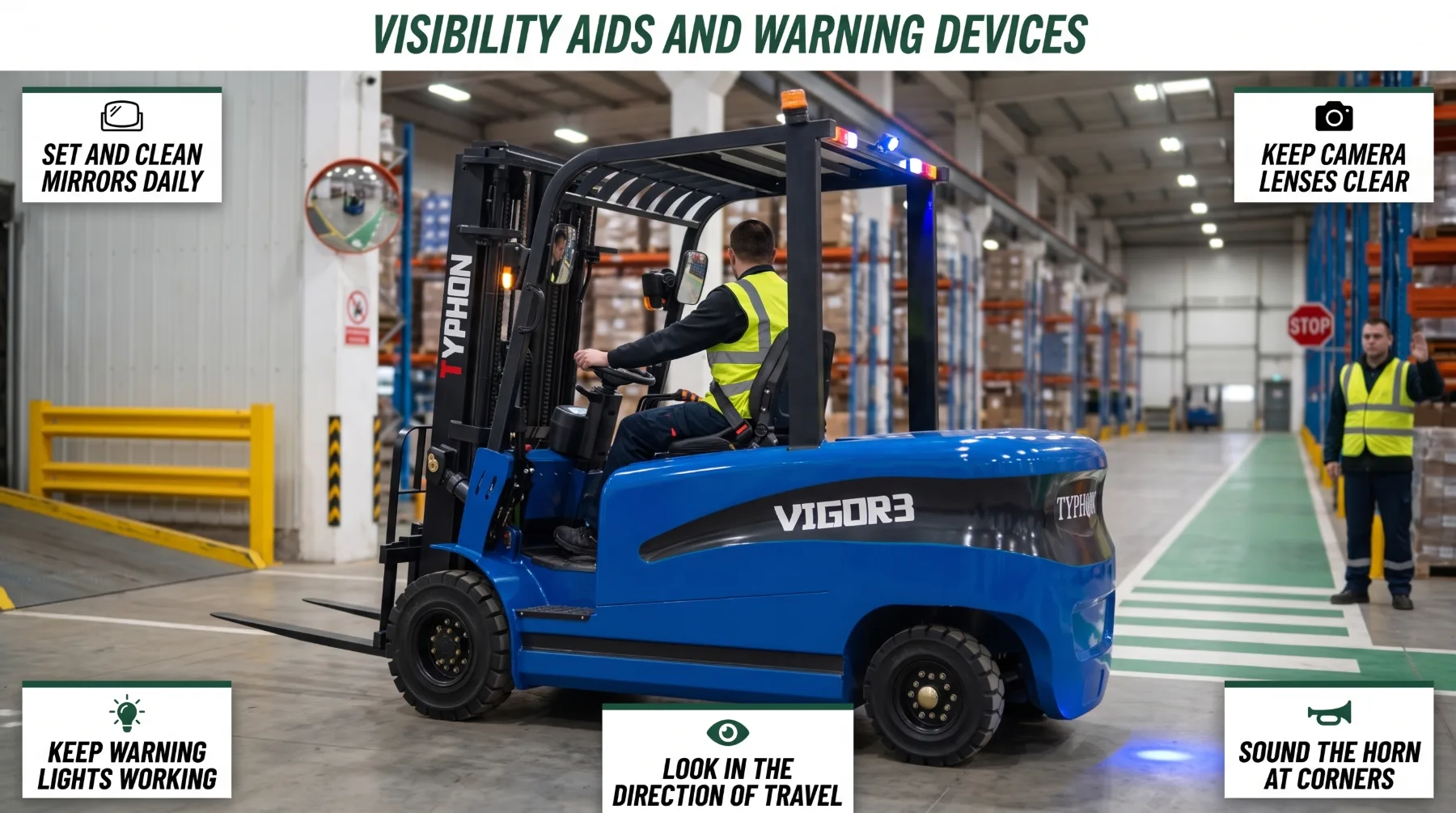
Each device fills a different role. Rearview and convex mirrors help the operator check areas beside and behind the machine. Rear cameras show the space close behind the counterweight, where blind spots are largest. Headlights and work lights illuminate the travel path and the load. Blue or red pedestrian warning lights project a spot or zone on the floor so people can see a forklift approaching, even around corners or behind racking. The horn signals the operator's presence at intersections, doorways, and blind corners, and backup alarms warn people when the machine reverses. Some forklifts also offer proximity detection systems that alert the operator when a person or object enters a set zone.
However, these devices can't eliminate all blind spots or replace direct checks of the travel route. A camera lens can be coated with dust or fogged by cold, a mirror can be bumped out of position, and a person can step into view a moment after the operator looks. Alarms lose their value when workers grow used to them, and a light means little in direct sunlight. Operators should look in the direction of travel, check mirrors and screens, and confirm that the path is clear before every move. When a load blocks forward view, travel in reverse where it's safe and permitted, or use a trained spotter.
Keep every device working and never disable one. Taping over an alarm, unplugging a light, or ignoring a dead camera removes protection that other workers rely on. Clean lenses, mirrors, and lights at the start of each shift and as conditions require, and report failures for repair. Sound the horn where site rules require it, and use a spotter when site procedures call for one. Site layout matters as well. Painted walkways, barriers, controlled crossing points, and clear rules about where pedestrians may walk all reduce the chance that a person and a forklift meet unexpectedly.
Key takeaway: Mirrors, cameras, lights, horns, and alarms improve awareness around a forklift, but they can't eliminate blind spots, so keep them clean and functional, never disable them, and always check the travel route directly before moving.
Inspections and Operator Training
Every feature described in this guide protects people only when it's present and working. Pre-shift checks confirm that the forklift is ready for safe operation before it moves a single load. In the United States, forklifts are generally required to be examined before being placed in service each day, or after each shift when they run around the clock.
A thorough pre-shift check covers the brakes, parking brake, steering, tires, forks, hydraulics, warning devices, restraints, and any installed safety systems. Inspect the forks for cracks, bends, and heel wear, and confirm that locking pins seat fully. Check the lift chains for stretched links, cracks, and uneven tension, and look for leaks around the mast, tilt cylinders, and hoses. Never search for a hydraulic leak with your hands, since pressurized fluid can penetrate skin and cause serious injury. Use a piece of cardboard instead. Confirm that the overhead guard, backrest, and capacity plate are present and undamaged. Test the horn, lights, backup alarm, camera, and seat belt, and check the fuel system or battery according to the manufacturer's procedure.
Defects affecting safe operation should be reported and corrected before the equipment returns to service. Tag the forklift out, remove the key, and record the problem in the inspection log so the next operator doesn't pick up a machine with a known fault. Repairs should be completed by qualified technicians using parts that meet the manufacturer's specifications.
Training holds the entire system together. Operators need appropriate training and authorization for the forklift type and workplace conditions they'll face. A worker experienced on stand-up warehouse trucks isn't automatically prepared for a pneumatic-tire forklift on gravel and ramps. In the United States, federal rules require formal instruction, practical training, and an evaluation of the operator's performance in the workplace, with performance evaluations at least once every three years. Refresher training is also required after an incident or near miss, after unsafe operation is observed, or when the operator moves to a different type of truck or workplace conditions change. Training should cover the specific machine's safety features, capacity plates, load center, stability, pedestrian awareness, and the site's traffic rules.
Key takeaway: Complete a pre-shift inspection of brakes, steering, tires, forks, hydraulics, warning devices, restraints, and safety systems before every shift, tag out defects, and make sure every operator is trained and authorized for the specific forklift and workplace.
Conclusion
Forklift safety features provide essential layers of protection in warehouses and on construction sites, but their effectiveness depends on regular inspection, proper use, and operator training. The overhead guard helps protect against falling objects, while seat belts and operator restraints help keep the driver within the protected zone during a tip-over. A load backrest and secure forks help prevent materials from shifting toward the operator, while mirrors, cameras, lights, horns, and alarms improve awareness around moving equipment. Stability systems and load-handling indicators offer additional support but do not replace the rated capacity, load center requirements, or sound operating judgment. Before each shift, inspect the overhead guard for damage and confirm that the load backrest is installed. Check forks for cracks, bends, and heel wear, ensure both forks sit level, and verify that locking pins and attachments are secure. Examine the lift chains, mast, and hydraulic hoses for wear or leaks, using cardboard rather than hands to check for pressurized leaks. Inspect tires, the fuel system or battery, and fluid levels according to the manufacturer's procedures. Clean mirrors, camera lenses, and lights, then test the horn, backup alarm, warning lights, and camera display. Fasten the seat belt and confirm that it latches correctly, then test the brakes, parking brake, steering, and hydraulic controls in a clear area. Check any load weight indicator and stability warnings, read the capacity plate for the current configuration, and review pedestrian routes and site traffic rules before starting work. Operators should never bypass safety devices or exceed rated capacity, and any defect affecting safe operation should be reported immediately. If a critical safety feature fails, remove the forklift from service until the problem is corrected. Consistent inspections, proper training, and respect for equipment limits help protect workers, prevent material damage, and maintain dependable forklift operations
Frequently Asked Questions
What safety features are common on forklifts?
Depending on the model, features may include overhead guards, seat belts, load backrests, horns, lights, mirrors, cameras, backup alarms, pedestrian warning lights, and operator restraint systems. Some forklifts also include load weight indicators, speed limiting, tilt control, and other stability-related systems. Check the operator's manual to learn which features your machine has and how they work.
Do forklift safety systems replace operator training?
No. Operators still need proper training, authorization, pre-use inspections, and compliance with workplace procedures. Safety systems vary by model and can't prevent every unsafe action, so operators must understand capacity plates, load center, stability, and pedestrian awareness for the specific forklift and site.
Why should forks be inspected daily?
Damaged or insecure forks can compromise load support and increase the risk of dropped materials. Cracks, bends, heel wear, uneven tips, and locking pins that don't seat fully can lead to sudden failure under load. Inspect forks before every shift, and remove the forklift from service if you find a defect.
Can warning lights and cameras prevent all collisions?
No. They improve awareness, but they must be supported by controlled travel, pedestrian separation, and direct checks of the surrounding area. Lenses get dirty, lights fade in sunlight, and people can step into blind spots without warning. Look in the direction of travel, sound the horn where required, and use a spotter when visibility is limited.