
Nov 12, 2026
Setup Procedures for Safe Scissor Lift Operation
Most scissor lift incidents begin on the ground, minutes before the platform rises. A wheel sits beside an uncovered floor opening, or the lift is parked on a slab section that was never rated for its weight. Sometimes a joist sits right above the work area and nobody looks up, or the platform holds more people and material than its rating allows.
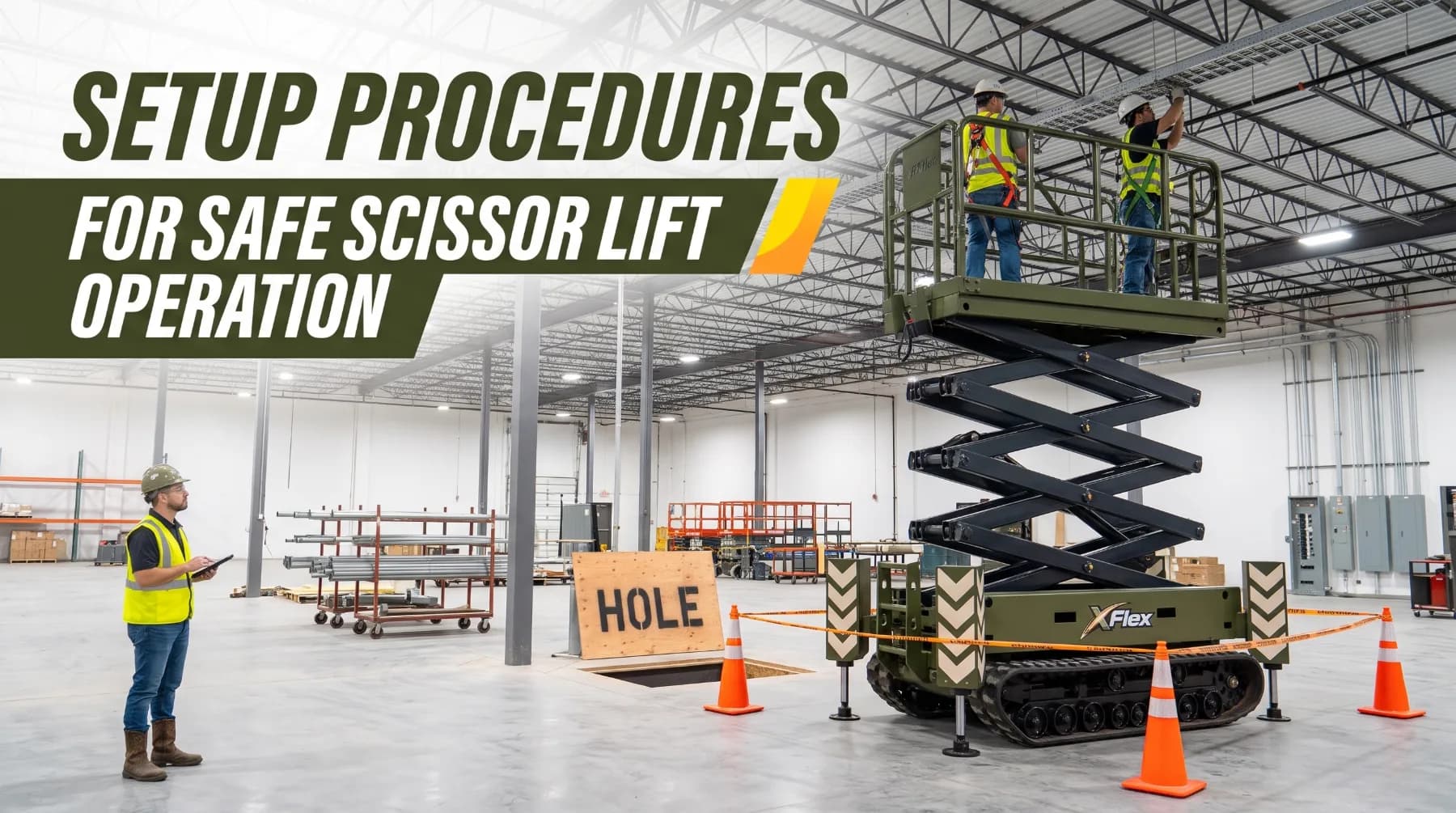
Most scissor lift incidents begin on the ground, minutes before the platform rises. A wheel sits beside an uncovered floor opening, or the lift is parked on a slab section that was never rated for its weight. Sometimes a joist sits right above the work area and nobody looks up, or the platform holds more people and material than its rating allows. Once the platform is elevated, these conditions become tip-overs, falls, electrocutions, and crushing injuries. Safe scissor lift operation depends on getting the setup right first.
Scissor lifts are everyday tools for electricians, HVAC technicians, drywall and ceiling crews, sprinkler fitters, painters, and facility maintenance teams. Their simple design makes them easy to underestimate. The controls are intuitive, and the platform feels stable on a smooth floor, so crews may skip steps when a job looks routine. A complete setup routine usually takes only a few minutes. Those minutes protect the people on the platform, the people below it, and the facility around it.
Inspecting the Scissor Lift Before Setup
A thorough pre-operation inspection is the foundation of every safe shift. Follow the manufacturer's pre-start checklist, and work around the machine in the same order each time so nothing gets missed. Start by confirming that the operator's manual is stored in its weatherproof container on the platform. Then check that capacity decals, control labels, and warning decals are present and legible. A machine with missing or unreadable decals hasn't been properly maintained and shouldn't go into service.
Next, inspect the parts that connect the machine to the ground. Check tires and wheels for cuts, chunking, embedded objects, and loose lug nuts. On rough terrain models, check pneumatic or foam-filled tires against the manufacturer's specification. Look at the scissor arms, pivot pins, pin retainers, and the lift cylinder for cracks, bends, missing hardware, and leaks. Confirm that the pothole protection bars are undamaged and move freely, and that the maintenance safety arm is present and in working condition.
The platform deserves particular attention. Seated earthmoving machines rely on a roll-over protective structure and a seat belt to protect the operator. A scissor lift relies on its guardrail system as the primary fall protection. Check every top rail, mid-rail, and toe board for damage, and confirm that removable rail pins are present and secured. The entry gate or chain should close and latch reliably, and self-closing gates should swing shut on their own. If the machine has an extension deck, slide it out and back to confirm it moves smoothly and locks in position.
Check the power system and hydraulics as well. On electric models, confirm the battery charge level and check electrolyte levels on flooded batteries according to the manual. Inspect terminals for corrosion, and look over charger cords for damage. On engine-powered models, check fuel, engine oil, and coolant. Inspect hydraulic hoses and fittings for leaks and abrasion. Never use your hand to search for a hydraulic leak. Fluid escaping under pressure can penetrate skin and cause an injection injury that requires immediate emergency medical treatment. Use a piece of cardboard instead, and wear gloves and eye protection.
Report every defect before the machine is used. A lift with damaged guardrails, faulty controls, leaking hydraulics, or a malfunctioning safety device must be tagged out and removed from service until a qualified technician repairs it. Never work beneath an elevated platform supported only by hydraulic pressure. Before any inspection or service beneath the platform, raise it only as the manufacturer instructs and engage the maintenance safety arm. Then shut the machine down, disconnect power, and apply your site's lockout and tagout procedure.
Key takeaway: Complete the manufacturer's pre-start inspection every shift, treat the guardrail system as the primary fall protection, check hydraulics with cardboard rather than your hands, and tag out any defective lift until it's repaired.
Evaluating the Ground and Work Area
Every scissor lift's stability depends on the surface beneath it. The machine must sit on a firm, stable surface capable of supporting its full weight plus the platform load. Manufacturers design and test their machines on level, solid ground, so ground conditions that fall short of that standard reduce the stability margin before the platform even rises. Walk the full work area and travel path before driving the lift in.
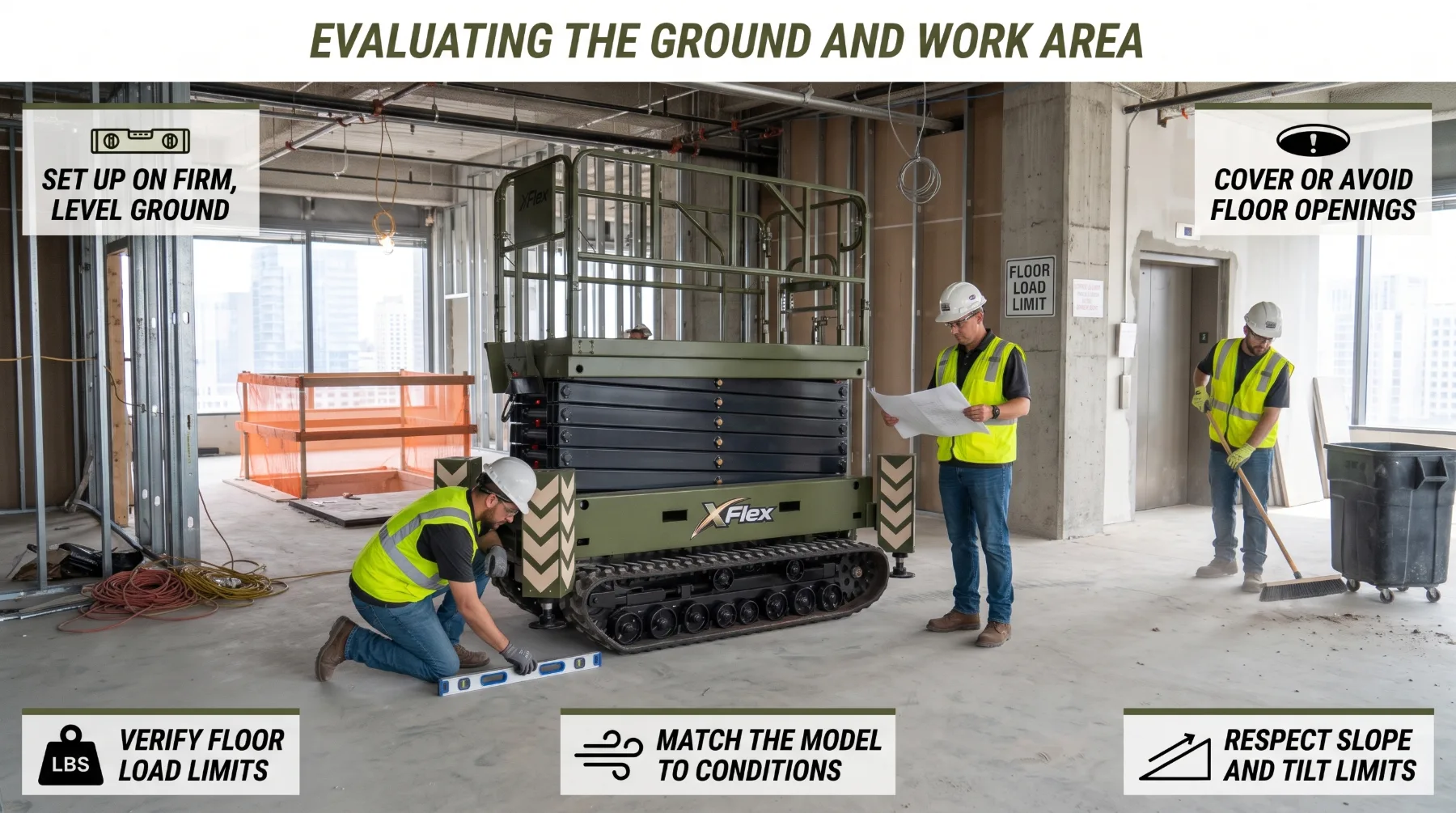
Look closely for anything that could cause a wheel to drop or sink. Potholes, floor openings, utility trenches, drains, and unprotected slab edges are obvious hazards, but smaller problems matter too. Debris, cords, loose plywood, ramps, curbs, and expansion joints can jolt an elevated platform. Outdoors, soft soil, recent backfill, wet ground, and asphalt softened by summer heat can let wheels settle unevenly. Cover floor openings with secured, clearly marked covers rated for the load, or keep the machine well away from them.
Slope limits need strict attention. Each manufacturer specifies the maximum gradient for driving the lift in the stowed position. Most scissor lifts may only be raised on level ground within a narrow tilt tolerance. Many models sound a tilt alarm and restrict lifting and driving when the chassis is out of level. Never treat that alarm as a nuisance. When it sounds, lower the platform and move the machine to level ground.
Indoor work brings a hazard that's easy to miss: floor load limits. A scissor lift concentrates substantial weight through its wheels, and manufacturers publish maximum wheel load and ground bearing figures for that reason. Compare those figures with the capacity of the surface before driving onto mezzanines, suspended slabs, raised access floors, parking decks, or freight elevators. Consult the facility manager or a structural engineer whenever the capacity is uncertain. Consider a tenant fit-out on the second floor of an older building. The slab may have been designed for office loads, not a loaded lift working in one spot all day.
Confirm that the machine suits the environment. Many slab scissor lifts are rated for indoor use only and carry no wind rating. Outdoor-rated models have specific maximum wind speeds and often lower platform capacities outdoors. Check the weather forecast, and stop work during high winds, lightning, or other severe conditions. Indoors, engine-powered lifts produce carbon monoxide that can build up quickly in enclosed spaces, so electric models are usually the better choice.
Key takeaway: Set up only on firm, level ground within the manufacturer's slope limits, cover or avoid floor openings, verify floor load capacity on every elevated or suspended surface, and use a model rated for the indoor or outdoor conditions.
Checking Overhead and Surrounding Hazards
Once the ground checks out, look up. Overhead hazards cause some of the most serious scissor lift injuries, particularly crushing incidents. In these incidents, an operator is pinned between the guardrail or controls and a beam, joist, duct, or pipe as the platform rises. Before raising the platform, identify every overhead obstruction in the work zone. That includes ceilings, structural steel, sprinkler piping, cable tray, light fixtures, ductwork, and door frames along the travel path.
Raise the platform slowly as it approaches overhead structures, and keep your eyes on the space above, not just the controls. Keep your body inside the guardrails and away from the edge of the platform closest to the obstruction. Some lifts include secondary guarding devices that stop or reverse movement when the operator is pressed against the controls. Confirm that these devices work during the function test. They support the operator's attention but don't replace it.
Check the surrounding area at ground level as well. Forklifts, delivery vehicles, other aerial lifts, and pedestrians can all strike or be struck by the machine. Set up cones, barricades, or barrier tape to create an exclusion zone around the base of the lift and beneath the platform. In occupied facilities such as warehouses, retail stores, schools, and hospitals, coordinate with facility staff so traffic and occupants are routed away from the work zone.
Protect people below from falling objects. Keep tools and materials inside the toe boards, use tool lanyards where required, and never throw items to or from the platform. Watch for environmental hazards too. Poor lighting, wet or icy decks, and hazardous atmospheres near process equipment can all affect safe operation. Address each one before work begins.
Key takeaway: Identify every overhead obstruction and raise the platform slowly near structures, maintain required power line clearances with a spotter, set an exclusion zone at ground level, and protect people below from falling objects.
Positioning the Scissor Lift Correctly
Good positioning puts the work within comfortable reach so nobody is tempted to stretch, lean, or climb. Before raising the platform, place the lift where workers can reach the task while standing on the platform floor with both feet down. Never lean over the guardrails, sit or stand on them, or use ladders, buckets, planks, or boxes on the platform to gain height. If the work can't be reached safely, lower the platform and reposition the machine. Using the extension deck is another option where the manufacturer permits it.
Approach the setup position carefully. Drive in the stowed position whenever possible, at a speed suited to the floor and nearby activity, and watch the full path for obstructions and people. Some lifts may be driven while elevated, but only on firm, level surfaces and within the manufacturer's limits. Many models automatically reduce drive speed once the platform rises above a set height. Avoid sudden starts, stops, and turns, which create dynamic forces that unsettle an elevated platform.
Keep the machine well back from unprotected edges, loading docks, trenches, excavations, and floor openings. Remember that wheels can drift toward an edge during minor repositioning. Plan the position so the lift won't need to move toward a drop-off during the task. Where work is needed close to an edge, install edge protection or barriers first.
Secure the machine once it is in position. Most electric scissor lifts apply their brakes automatically when the drive control is released. Confirm that the brakes hold before raising the platform, and chock the wheels if the manual requires it. Some rough terrain models use outriggers or leveling jacks. Deploy these fully on firm ground or approved load-spreading pads exactly as the manual instructs, and confirm that any outrigger interlocks show the machine is ready. Check the level indicator, and make sure the pothole protection bars deploy as the platform begins to rise.
Enter and exit only when the platform is fully lowered. Use the designated entry point and steps, maintain three points of contact, and close the gate or chain behind you before operating the controls. Never use the lift as a crane, never attach it to adjacent structures, and never move the machine while anyone is climbing on or off.
Key takeaway: Position the lift so the work is within easy reach from the platform floor, approach slowly, keep well back from edges and openings, confirm brakes, outriggers, and level before raising, and enter or exit only with the platform fully lowered.
Confirming Platform Load and Safety Equipment
Every scissor lift has a rated platform capacity, shown on the capacity decal and in the operator's manual. That figure includes the combined weight of every worker, tool, and piece of material on the platform. It's a firm limit, not a guide. Calculate the total load before raising the platform, and include often-forgotten items such as tool belts, battery packs, fixtures, cable reels, and packaging. Many lifts also limit the number of occupants separately from the weight rating.
Capacity often changes with conditions. Many models carry different ratings for indoor and outdoor use, because wind adds force to the platform outdoors. Consider a lift rated for two people and 500 pounds indoors but only one person and 250 pounds outdoors. A crew that moves the same machine from a warehouse to an exterior canopy without rechecking the rating could be overloaded immediately. Extension decks typically carry their own lower limit. Read every capacity line on the decal, not just the largest number.
Distribute weight evenly across the platform, keep materials secured, and don't let long items such as conduit or pipe extend past the guardrails. Avoid pushing or pulling hard against walls, ceilings, or structures from the platform. Manufacturers specify a maximum manual side force, and exceeding it can affect stability. Many lifts include load sensing systems that prevent raising when the platform is overloaded. Never bypass, disable, or override these systems. If the system stops the lift, remove weight and recheck the load.
Confirm the fall protection setup before raising the platform. On scissor lifts, guardrails are generally the primary fall protection, so every rail must be in place and the gate or chain closed. Use personal fall protection when the manufacturer, your employer, or site rules require it. Attach lanyards only to the manufacturer's designated anchor points, never to guardrails or nearby structures unless the manufacturer specifically approves them. Fit the lanyard length so it keeps the worker on the platform.
Personal protective equipment completes the picture. Workers on the platform and on the ground should wear hard hats, safety glasses, high-visibility clothing, gloves suited to the task, and sturdy safety footwear. Add hearing protection where noise requires it. Secure tools with lanyards when working above occupied areas, and keep the platform clear of loose debris that could become a trip hazard or fall to the ground.
Key takeaway: Calculate the full platform load against the correct indoor, outdoor, and extension deck ratings, distribute and secure materials, never bypass load sensing systems, keep guardrails complete, and use personal fall protection only at approved anchor points.
Testing Controls and Emergency Procedures
A function test confirms that the machine responds correctly before anyone depends on it at height. Perform the test at the start of each shift in a clear area with no overhead obstructions. Start at the ground control station, then move to the platform controls, following the sequence in the operator's manual. Operators must be trained on the specific model and familiar with every control before they begin. In the United States, ANSI A92 standards and OSHA require operator training, and the employer must provide familiarization on each machine type.
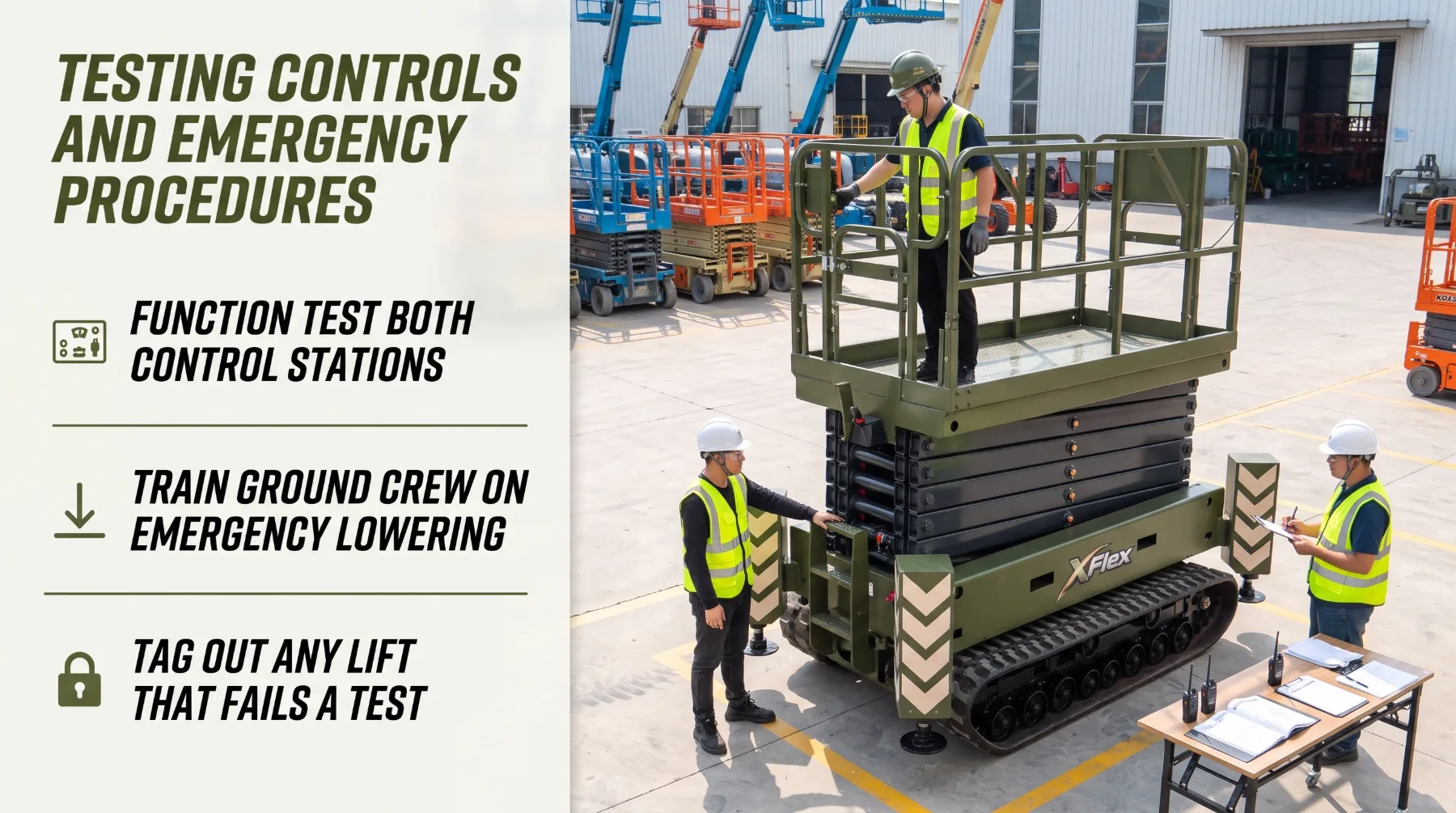
Emergency lowering deserves special attention. Every scissor lift includes a manual lowering valve or auxiliary lowering system for use if power or hydraulics fail. Ground personnel need to know exactly where it is and how to operate it, because they may be the only people who can bring the platform down. Practice the procedure according to the manual, and make sure everyone involved knows which personnel are trained to use it.
If any function fails during the test, stop. Lower the platform, shut down the machine, remove the key, apply your lock and tag, and report the fault. Keep the lift out of service until a qualified technician repairs it and the machine passes a complete function test.
Key takeaway: Function test every control and safety device at both stations each shift, make sure ground personnel can operate emergency lowering, put a rescue plan in place before work at height, and tag out any lift that fails a test.
Conclusion
Safe scissor lift operation begins long before the platform leaves the ground. A thorough pre-start inspection confirms that guardrails, controls, hydraulics, and safety devices are ready. Evaluating the ground protects against unlevel surfaces, floor openings, and overloaded slabs, while checking overhead and surrounding hazards prevents crushing, power line contact, and collisions. Correct positioning keeps work within reach so nobody leans or climbs. Verifying platform load and safety equipment keeps the machine within its limits, and testing controls and emergency procedures prepares the crew for anything that goes wrong at height.
Frequently Asked Questions
What should be checked before operating a scissor lift?
Complete the manufacturer's pre-start inspection before every shift. Check tires and wheels, scissor arms, pins, the lift cylinder, guardrails, toe boards, the entry gate, the extension deck, and the decals. Inspect the battery or engine fluids and the hydraulic system, using cardboard rather than your hands to check for leaks. Then function test the ground and platform controls, emergency stops, brakes, pothole protection, tilt alarm, and emergency lowering system. Remove any defective lift from service until it's repaired.
Can a scissor lift operate on uneven ground?
Only within the manufacturer's specified limits for that model. Most scissor lifts may be driven in the stowed position on modest grades but must be raised only on firm, level ground within a narrow tilt tolerance. Rough terrain models handle uneven outdoor surfaces better, and some use outriggers or leveling jacks. They still have firm slope and ground limits. If the tilt alarm sounds, lower the platform and move the machine to level ground before continuing.
Should workers lean over scissor lift guardrails?
No. Workers should stay inside the platform with both feet on the floor. Never lean over, sit on, or climb the guardrails, and never use ladders, buckets, or planks on the platform to gain height. Leaning shifts weight toward the edge and creates a serious fall risk. If the work is out of reach, lower the platform and reposition the machine, or use the extension deck where the manufacturer permits it.