
Sep 5, 2026
Why Skid Steer Stability Changes With Different Attachments
A skid steer is one of the most versatile machines on any job site, capable of switching from a bucket to a set of pallet forks to a hydraulic breaker in minutes.
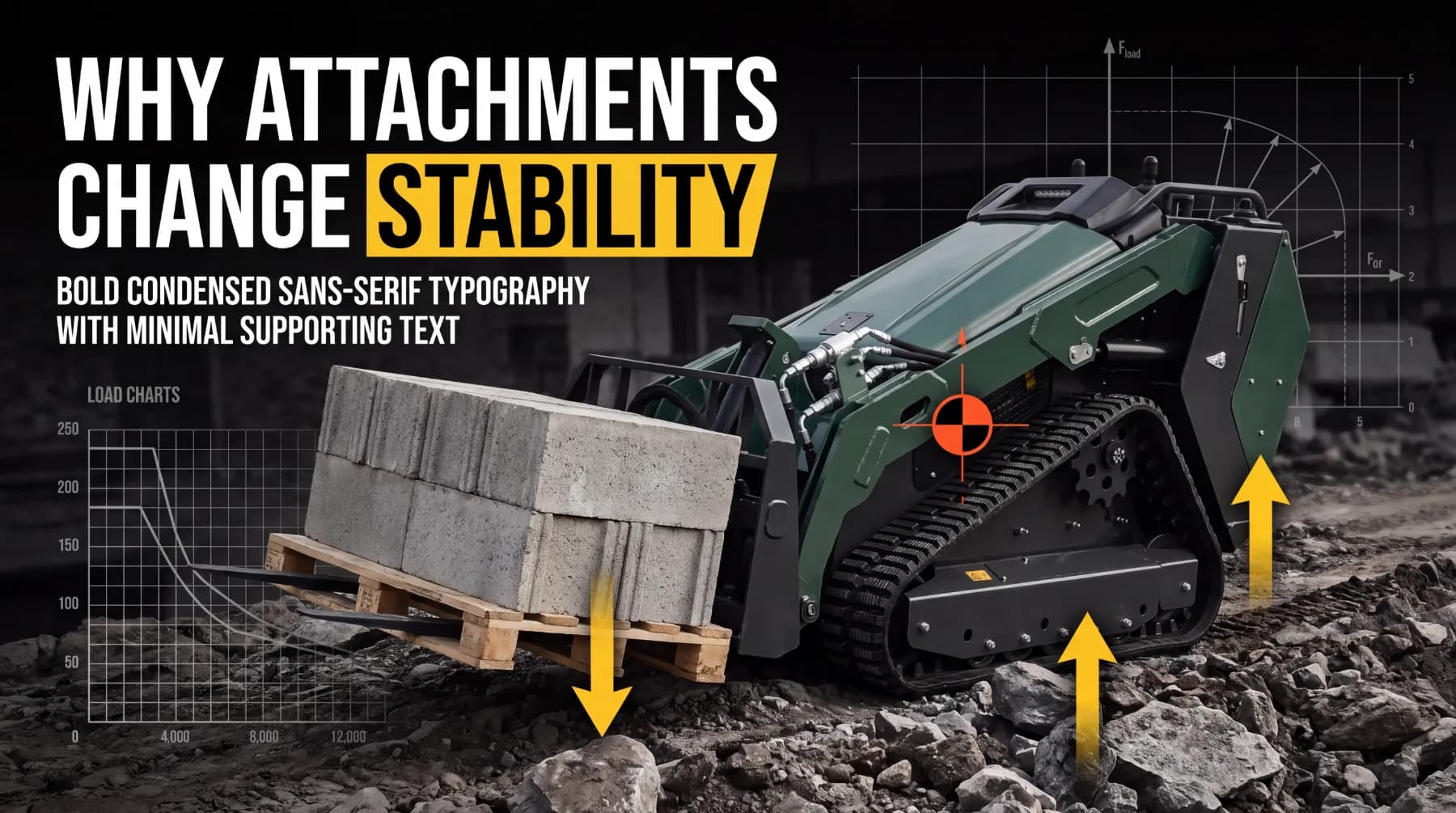
A skid steer is one of the most versatile machines on any job site, capable of switching from a bucket to a set of pallet forks to a hydraulic breaker in minutes. That versatility is exactly why stability matters so much. Every attachment you mount changes how the machine carries weight, where its balance sits, and how confidently it can lift and travel. A skid steer that feels rock-solid with one attachment can feel tippy and uncertain with another. Understanding why this happens helps you work safely, protect your equipment, and get the most from every tool you attach. This guide explains how attachment weight, size, lift height, and rated capacity all shape stability, and how to match the right attachment to your machine.
Attachment Weight Changes the Load Balance
Every attachment adds weight to the front of the skid steer, and that weight directly affects how the machine balances. A skid steer is engineered around a careful distribution of weight between the front and rear, with the rear of the machine acting as a counterbalance to whatever it carries up front. When you mount a heavier attachment, you add load to the front end, which shifts the combined center of gravity forward. The farther that balance point moves toward the front wheels, the less margin the machine has before it becomes unstable, especially when lifting.
This shift matters most during lifting and travel. A lightweight attachment leaves plenty of counterbalance in reserve, so the machine stays planted and predictable. A heavy attachment, by contrast, uses up much of that reserve before you even pick up a load. Add material to the bucket or forks, and the front end carries even more, pushing the balance point further forward and reducing the machine's tipping margin.
Consider how attachment weight influences daily operation:
- Light attachments such as brooms or small buckets leave more counterbalance in reserve and keep the machine stable.
- Heavy attachments such as grapples, augers, or large buckets shift weight forward and demand more caution.
- Loaded attachments compound the effect, since the material adds to the weight already carried at the front.
Because attachment weight sets the starting point for the machine's balance, it is the first factor to check before you mount anything. Knowing an attachment's weight, and how it compares to what your skid steer is rated to handle, tells you how much stability margin you have to work with.
Attachment Size Affects the Center of Gravity
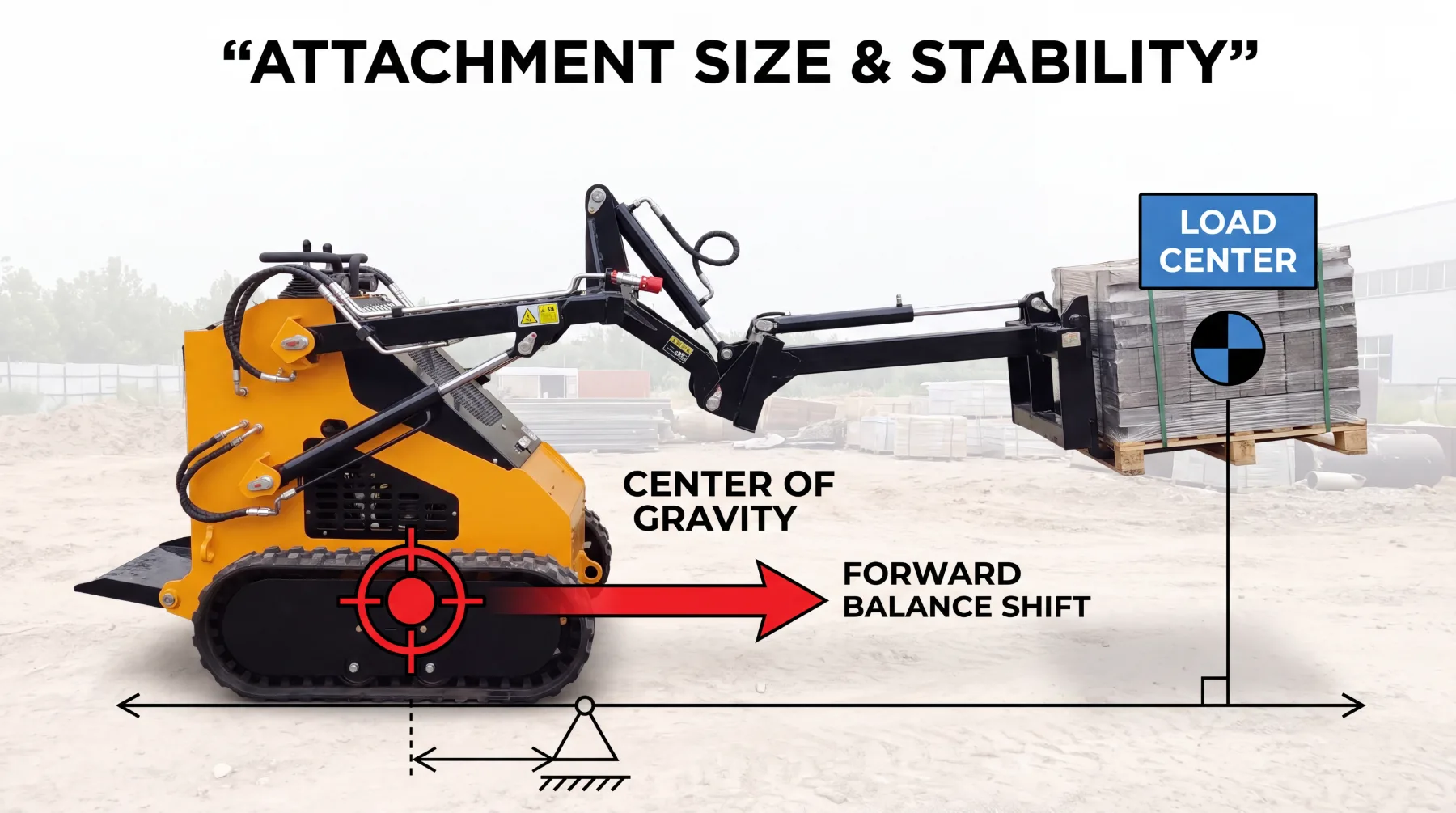
Weight alone does not tell the whole story. The size and shape of an attachment, particularly how far it extends from the machine, also play a major role in stability. When an attachment reaches farther forward, it moves the combined center of gravity away from the machine and toward the front wheels. This happens because weight held at a distance exerts more leverage than the same weight held close in. A long attachment, or one that carries its load well ahead of the coupler, can reduce stability even if it is not especially heavy.
This is why load center is such an important concept. The load center is the distance from the attachment's mounting point to the center of the load it carries. An attachment that holds material close to the machine keeps the balance point rearward and preserves stability. An attachment that carries or extends its load far forward pushes the balance point ahead, giving the machine less room before it wants to tip. Two attachments of equal weight can behave very differently simply because one reaches farther than the other.
The effect grows sharper when the load is raised. An extended attachment holding a load out front and up high combines two stability challenges at once, distance and elevation. In these situations, even a moderate load can feel far less secure than the numbers alone suggest. When choosing an attachment, look beyond its weight and consider its dimensions and how far it positions the load from the machine. A compact attachment that keeps loads close will nearly always offer better stability than a long-reaching one of similar weight, and that difference shapes how safely the machine performs.
Lift Height Changes Stability
Raising an attachment introduces one of the most significant stability challenges a skid steer faces. When a load sits low and close to the ground, its weight stays near the machine's base, keeping the center of gravity low and the machine steady. As the lift arms rise, that weight climbs with them, and the center of gravity moves upward. A higher center of gravity gives the machine less resistance to tipping, which means stability decreases the higher you lift. This is why a load that feels perfectly secure at ground level can feel far less stable when raised to full height.
The challenge intensifies when height combines with weight and reach. Lifting a heavy attachment to maximum height stacks several stability factors on top of one another, and the machine's tipping margin shrinks accordingly. Add forward reach into the mix, and the load sits both high and far from the machine, placing the greatest possible demand on stability. These are precisely the conditions where operators need to be most careful and most aware of their machine's limits.
A few practices help maintain stability when lifting:
- Keep loads low during travel and raise them only when you are ready to place them.
- Move smoothly and slowly when a load is elevated, avoiding sudden turns, stops, or starts.
- Respect rated limits at height, since a machine's safe capacity is lower with the load raised than at ground level.
Understanding how lift height affects stability lets you plan each lift with confidence. When you handle heavy attachments or work at maximum height, treating stability as the priority protects both the operator and the equipment, and it keeps every lift under control.
Rated Capacity Varies by Attachment
It is a common assumption that a skid steer has a single lifting capacity that applies no matter what it is doing. In reality, the same machine can perform quite differently depending on the attachment mounted to it. Rated operating capacity is calculated with the machine's balance in mind, and because each attachment changes that balance, the practical capacity shifts from one attachment to the next. An attachment that is heavy, extends far forward, or carries its load at a distance effectively reduces how much additional weight the machine can safely handle.
Several attachment characteristics feed into this variation. Attachment weight uses up part of the machine's counterbalance before any load is added. Load position, meaning how far forward the load sits, affects the leverage acting against the machine. Hydraulic requirements also matter, since attachments that draw heavily on the hydraulic system can influence how the machine performs under load. Together, these factors mean the rated capacity you can count on with a light bucket is not the same as the capacity available with a heavy grapple or a long-reaching tool.
This is why it is essential to consider capacity in the context of the specific attachment you are using, rather than relying on a single number from the spec sheet. A responsible approach is to check the machine's rated operating capacity and understand how the attachment in question affects it. When you match your expectations to the real capacity available with each attachment, you avoid overloading the machine and keep operation safe and predictable. Treating capacity as something that changes with the attachment, rather than a fixed figure, is one of the most practical habits an operator can build.
Match the Attachment to the Skid Steer
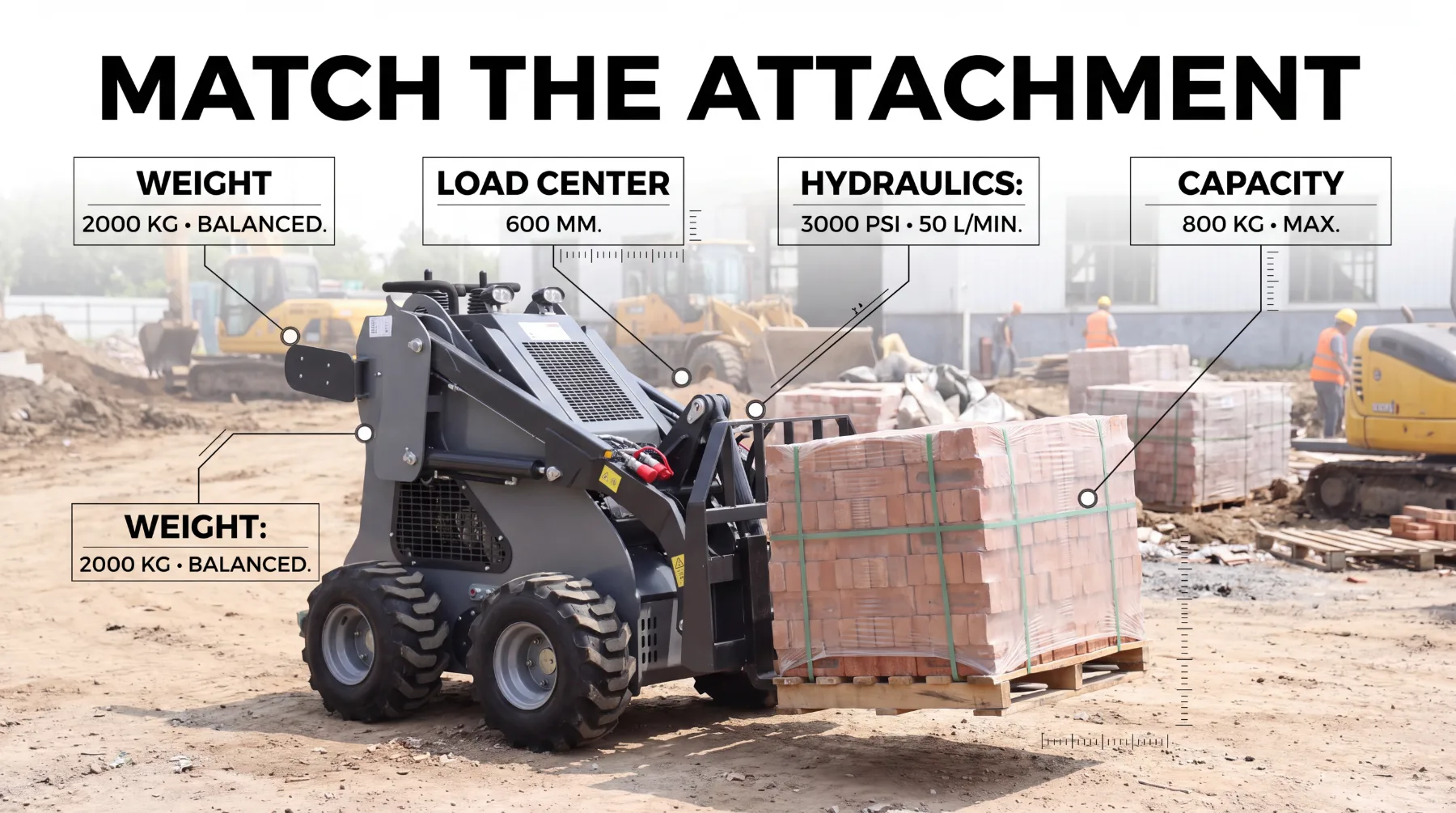
Choosing an attachment involves far more than confirming it will physically connect to the machine. A universal coupler may let almost any attachment mount easily, but fitting and performing safely are two very different things. To operate stably and productively, an attachment must suit the skid steer's weight, balance, hydraulic system, and rated capacity. Overlooking these factors can leave you with a combination that mounts perfectly yet handles poorly, reduces stability, or strains the machine beyond its comfortable limits.
A sound matching process weighs several considerations together rather than in isolation:
- Weight: confirm the attachment's weight fits within what the machine can carry while leaving a stability margin.
- Dimensions and load center: check how far the attachment extends and where it positions the load relative to the machine.
- Hydraulic requirements: verify the skid steer supplies the flow and pressure the attachment needs to work properly.
- Rated operating capacity: ensure the machine's capacity supports the attachment and the loads you plan to handle.
Taking the time to align these factors delivers real benefits. An attachment matched to the machine works smoothly, maintains stability through lifting and travel, and lets the operator focus on the task rather than fighting the equipment. A poorly matched attachment does the opposite, creating instability, slowing the work, and adding unnecessary risk. Before you commit to an attachment, look past whether it fits and ask whether it truly suits the machine and the job. When the attachment, the skid steer, and the workload are properly aligned, the result is stable, efficient, and dependable operation you can trust on every shift.
Conclusion
Skid steer stability is never fixed, because every attachment changes the equation. Attachment weight shifts the load balance toward the front, size and reach move the center of gravity forward, and lift height raises that balance point higher and reduces the tipping margin. Rated capacity varies right along with these factors, so the same machine performs differently depending on what it carries. The way to stay safe and productive is to match each attachment to the skid steer's weight, dimensions, hydraulic needs, and rated capacity, rather than simply checking that it fits. When you understand how these elements work together, you can choose the right attachment, respect the machine's limits, and keep every lift stable and controlled from the first shift onward.
Frequently Asked Questions
- Why does a skid steer feel less stable with some attachments than others?
Stability changes because every attachment alters how the machine carries and balances weight. A skid steer is designed with a careful balance between the front load and the rear counterweight. Heavier attachments add weight to the front, which shifts the center of gravity forward and reduces the tipping margin. Attachments that extend farther from the machine or carry their load at a distance push that balance point even further ahead. As a result, an attachment that is heavy, long, or positions its load far forward will feel less stable than a light, compact one, even on the same machine. - How does attachment weight affect lifting capacity?
Attachment weight uses up part of the machine's counterbalance before any load is added, which directly reduces how much additional weight the skid steer can safely handle. The rear of the machine acts as a counterweight to whatever it carries up front, so a heavier attachment leaves less capacity in reserve for the load itself. This is why the practical lifting capacity available with a light bucket differs from the capacity available with a heavy grapple or auger. Always account for the attachment's weight when planning a lift, and treat rated capacity as something that changes with each attachment rather than a single fixed number. - Why does lifting a load higher make a skid steer less stable?
When a load sits low and close to the ground, its weight stays near the machine's base, keeping the center of gravity low and the machine steady. As the lift arms raise the load, that weight climbs with it and the center of gravity moves upward. A higher center of gravity offers less resistance to tipping, so stability decreases the higher you lift. The effect is strongest when height combines with a heavy attachment and forward reach, placing the load both high and far from the machine. To stay safe, keep loads low while traveling, move slowly when a load is raised, and respect the machine's lower rated limits at height. - What is load center and why does it matter for stability?
Load center is the distance from the attachment's mounting point to the center of the load it carries. It matters because weight held at a distance exerts more leverage than the same weight held close to the machine. An attachment that keeps its load close preserves stability, while one that carries or extends its load far forward pushes the center of gravity toward the front wheels and reduces the tipping margin. This is why two attachments of equal weight can behave very differently. When choosing an attachment, consider not just its weight but how far it positions the load from the machine. - How do I know if an attachment is safe to use on my skid steer?
Start by looking beyond whether the attachment physically fits the coupler, since fitting and performing safely are not the same thing. Check the attachment's weight against what your machine can carry while leaving a stability margin, and review its dimensions and load center to understand how far it extends the load. Confirm that your skid steer supplies the hydraulic flow and pressure the attachment requires. Finally, compare the machine's rated operating capacity with the attachment and the loads you plan to handle. When weight, dimensions, hydraulic needs, and rated capacity all align with your machine, the attachment is well matched and safe for stable, dependable operation.